Few things are as distinctive as a traditional Cumbrian slate roof. From farmhouses in the fells to cottages in Grasmere, Coniston and Hawkshead, roofs of local green and blue-grey slate are part of the landscape and character of the region.
These roofs can last for generations – but they need the right care. Modern methods and materials are not always suitable, and the wrong repair can spoil the appearance and even shorten the life of the roof. In this guide, our slate roofing and heritage roofing specialists explain how traditional Lakeland slate roofs work and how to look after them.
What Makes Lakeland Slate Roofs Different?
Local slate
Cumbria has a long history of slate quarrying. Two of the best-known types are the green slates of the central Lake District (often referred to as Westmorland green slate) and the blue-grey slates from the Furness area, such as Burlington. Both are dense, durable and weather beautifully.
Diminishing courses
Traditional slate roofs are usually laid in diminishing courses – the largest, heaviest slates at the eaves, getting progressively smaller towards the ridge. Slates are often of random widths. This creates the characteristic texture of a Lakeland roof and makes the most efficient use of the quarried stone.
Thick, heavy slates
Local slates are often much thicker and heavier than imported slate, giving a rugged, textured appearance. Roof structures were built to carry this weight.
Traditional ridges and details
Many older roofs feature slate ridges – including interlocking “wrestler” ridges – stone ridges or clay ridges, along with lead or mortar details at chimneys and abutments. Some older roofs have lime mortar “torching” on the underside of the slates instead of modern underlay.
Common Problems With Traditional Slate Roofs
Nail sickness
The slates themselves can last well over a century, but the iron nails that hold them often corrode long before. When nails fail, slates slip one by one – a problem known as nail sickness. A few slipped slates can be refixed, but widespread nail sickness usually means the roof needs stripping and relaying.
Failed torching and underlay
Lime torching gradually crumbles and falls away, and early felt underlays can become brittle. This allows wind-driven rain and draughts into the roof space.
Decayed battens
Timber battens or laths can rot over time, especially if the roof has been damp. Rotten battens no longer hold nails securely.
Lead and mortar details
Chimneys, valleys and abutments are common leak points. Read our guides to roof flashing types and chimney repairs in Cumbria.
Inappropriate past repairs
Bitumen coatings, foam sprays, cement-heavy mortar and mismatched replacement slates can trap moisture, make future repairs difficult and spoil the appearance of the roof.
Own a Traditional Slate Roof?
Our team carries out sympathetic slate repairs and re-roofing using reclaimed and new local slate across Cumbria and the Lake District. Ask for a free survey.
Get a Free Quote →Call 01768 239415Sympathetic Repair: Doing It Properly
Refixing slipped slates
Individual slipped slates can be refixed using discreet copper or stainless steel clips (tingles) or by carefully re-nailing where access allows.
Stripping and relaying
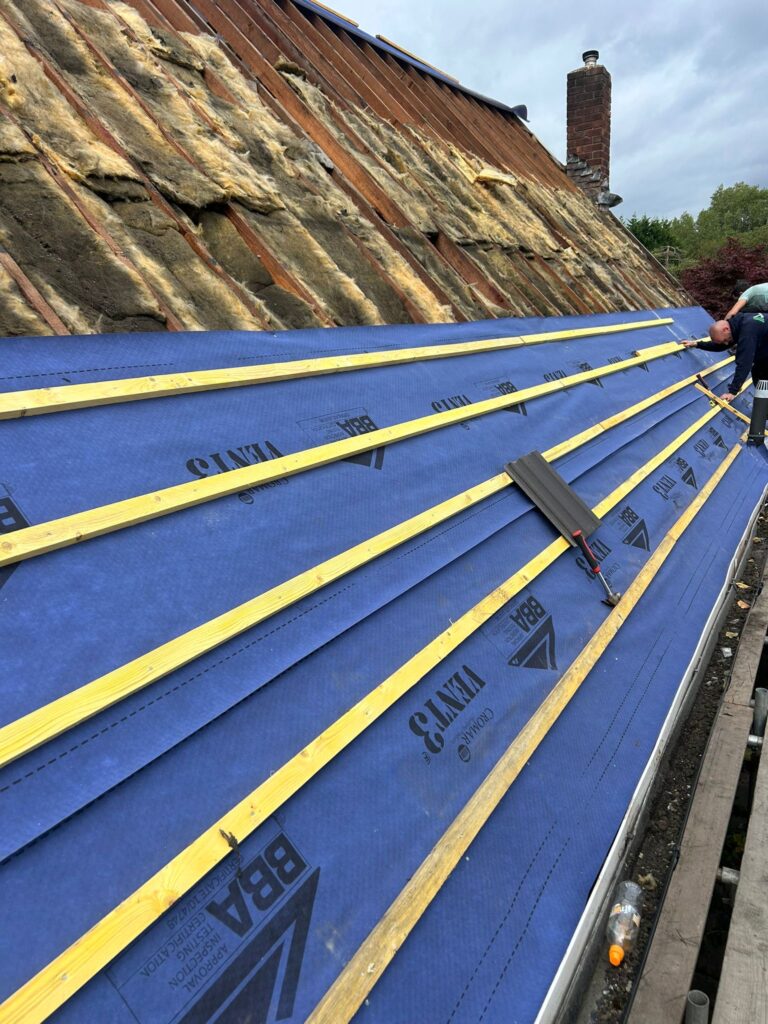
Where nail sickness or batten failure is widespread, the roof is carefully stripped, slates are sorted and graded, and sound slates are relaid on new battens and breathable underlay – in their original diminishing courses – using non-ferrous nails. Shortfalls are made up with matching reclaimed or new local slate.
Matching slate
Using the right slate is essential. Imported slates are often thinner, more uniform and a different colour, and they can look out of place on a traditional Lakeland building. Reclaimed local slate or new slate from Cumbrian quarries gives the best match.
Lead work and lime mortar
Traditional details are best repaired with traditional materials – lead flashings dressed by hand and breathable lime mortars rather than hard cement. Our specialist lead work team can help, and our article Lead vs Modern Roofing Materials explains the options.
Ventilation
When a traditional roof is relaid with modern underlay, ventilation needs careful thought to avoid condensation. See Loft Condensation and Roof Ventilation.
Listed Buildings, Conservation Areas and the National Park
Many traditional slate roofs are on listed buildings, in conservation areas or within the Lake District National Park. In these situations:
- Like-for-like repairs using matching materials are usually expected
- Changing the roof covering, ridge type or appearance may require consent
- Listed building consent may be needed for more than minor repairs
- It is always worth checking with the relevant planning authority before major work
An experienced heritage roofer will understand these requirements and can help you plan the work correctly.
Slate vs Other Roof Coverings
Natural slate is one of the longest-lasting roofing materials available. For a full comparison with tiles and other materials, read Roof Slate vs Roof Tiles and our guide to property types and architecture in Cumbria.
How to Care for a Traditional Slate Roof
- Arrange a professional inspection every few years and after severe storms
- Deal with slipped slates promptly before wind gets underneath
- Keep gutters clear – especially cast iron gutters, which can crack if water freezes inside
- Remove heavy moss carefully by hand, never with high-pressure washing
- Avoid coatings and spray foams on slate roofs
- Check lead work and chimneys regularly
Read Moss on Your Roof: Should You Remove It? and Why Are My Gutters Overflowing? for more maintenance advice.
Lakeland Slate Roof FAQs
How long does a traditional slate roof last?
Good-quality local slate can last well over a century. Nails, battens and underlay usually need renewing long before the slates do.
Can old slates be reused?
Yes. When a roof is stripped, sound slates are sorted and reused, with any shortfall made up from matching reclaimed or new slate.
Is relaying a slate roof expensive?
It is a skilled, labour-intensive job, but reusing existing slate helps control costs. See How Much Does Roof Repair Cost in Cumbria? for general guidance.
What if my slate roof is leaking now?
Contact our emergency roof repair team, and read what to do when your roof leaks.
Related Roofing Guides
Specialist Slate & Heritage Roofing in Cumbria
From refixing a few slipped slates to relaying a traditional Lakeland roof, our experienced roofers work sympathetically with local materials. Book your free survey today.
Schedule a Booking →📞 01768 239415Covering Penrith, Kendal, Carlisle, Keswick, Windermere, Appleby-in-Westmorland and across Cumbria.